
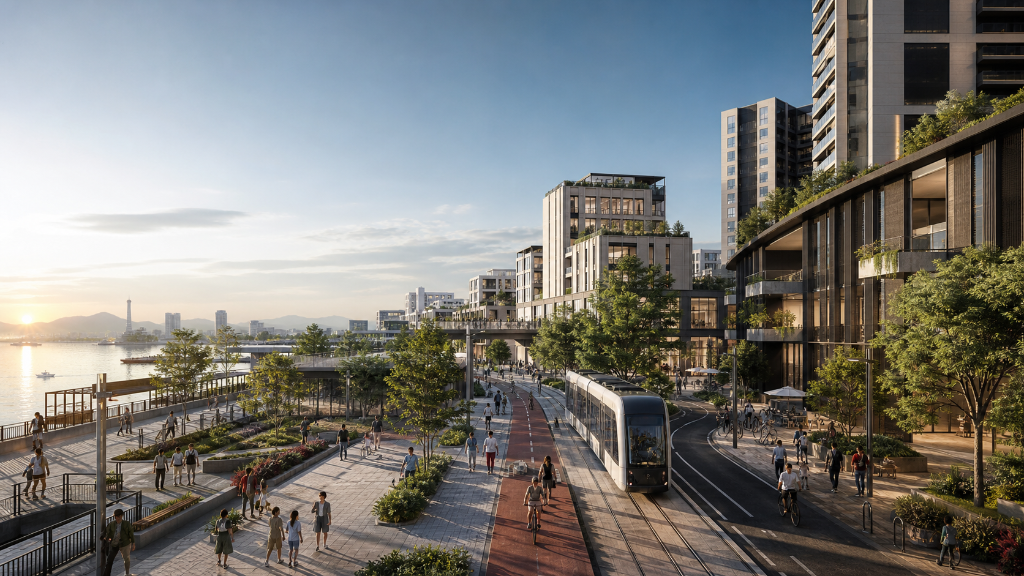
A city built
around people.
Project New Tokyo is the ambition to turn Tenkai's principles into a lived physical environment — a place where human potential, ecological responsibility, culture, and carefully governed intelligence can coexist.
A city should be a place to live fully — not a corporate campus, not a technology showroom, and not a controlled experiment. If Project New Tokyo is ever built, that principle governs everything.
No claim is made today that any site, construction, funding, opening date, or municipal partnership exists. This is a concept-stage vision.
City Pillars
Human-Centered Urbanism
Design that starts with people — how they live, rest, work, move, and connect — rather than infrastructure or technology.
Sustainable Systems
A city built around ecological responsibility: energy, water, materials, and long-term relationship with its environment.
Mobility & Infrastructure
Movement designed for people: walkable, accessible, and not structured around private vehicle dominance.
Civic Intelligence with Human Governance
Technology that serves the city without governing it. Decisions remain with residents and elected civic structures.
Culture & Creative Life
Space for art, performance, education, gathering, and the spontaneous cultural life that makes a city worth living in.
Research & Education
A built-in relationship with research institutions, universities, and the pursuit of knowledge as a civic value.
A horizon, not a schedule.
These stages reflect how a project of this scale would logically unfold. None of this represents completed work — it is a framework for thinking about what must be done.
Defining the values, design principles, and research questions that would guide everything that follows.
Identifying potential partners, academic institutions, urban planning experts, and feasibility frameworks.
Developing a detailed masterplan in collaboration with architects, urban planners, and civic experts.
A small-scale built environment as proof of concept and learning environment before phased expansion.
Gradual expansion over many years, governed by civic structures and guided by lived experience in earlier phases.